
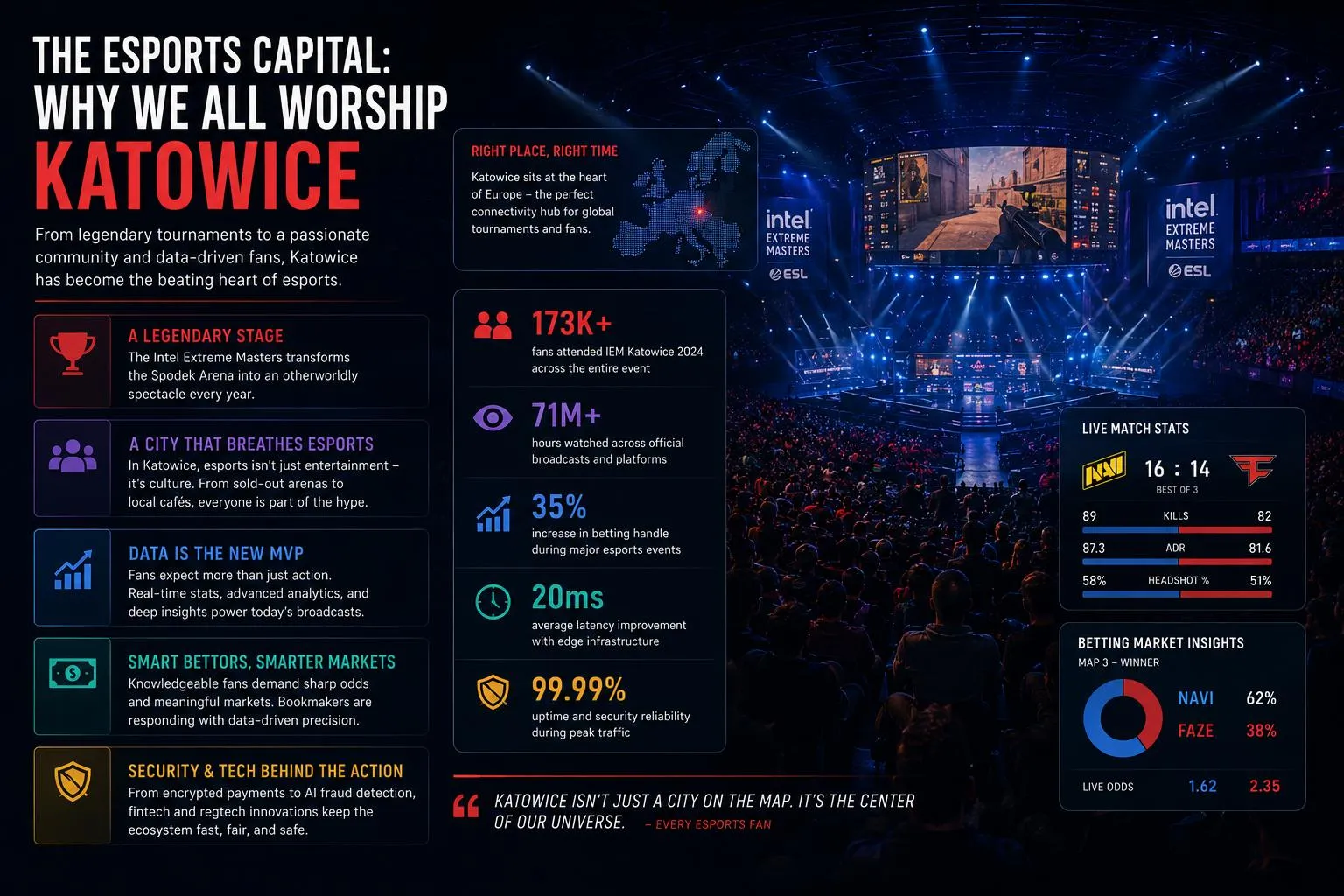
Let’s be real for a second. If you asked someone outside of the gaming bubble to name the biggest esports cities in the world, they’d probably guess Los Angeles, Tokyo, or Seoul. But ask anyone who has actually logged thousands of hours in Counter-Strike, and they will immediately point to a gritty, industrial city in Central Europe.
Katowice is basically our Mecca. Every year, the Intel Extreme Masters (IEM) rolls into town and turns a relatively quiet Polish city into the absolute center of the digital universe.
Inside the Flying Saucer
The magic of this event mostly comes down to the venue itself. The Spodek arena is a massive, weirdly beautiful stadium that legitimately looks like a UFO from a 1970s sci-fi movie.
Playing inside that dome is notoriously terrifying for away teams. The acoustics are so intense that when a local team wins a clutch round, the roar of the crowd physically shakes the stage. But it’s not just about the noise.
This crowd is educated. They don’t just clap for flashy sniper kills; they lose their minds over brilliant smoke-grenade lineups and perfect map rotations.
A City-Wide Obsession
What really sets Katowice apart, though, is how the entire regional culture embraces the chaos. Esports isn’t treated as some weird underground hobby here. It is a mainstream obsession.
It is entirely normal to see major Polish bookmakers treating a tier-one gaming tournament with the exact same reverence as the Champions League finals. They plaster odds on billboards and offer deep, analytical breakdowns of the matchups.
Katowice proves a massive point. You don’t need to be a flashy, sun-soaked mega-city to host the best gaming events on earth. You just need a community that absolutely breathes the game.
We Are All Data Nerds Now: The Analytics Revolution in Esports
Think back to what watching competitive gaming looked like ten years ago. You would pull up a horribly compressed stream on your second monitor, squint at the pixels, and cheer whenever the kill feed lit up.
Things have changed drastically. The average League of Legends or Valorant viewer today is basically an amateur data scientist. We aren’t just watching the gameplay anymore; we are aggressively analyzing real-time spreadsheets.
The “Moneyball” Era of Gaming
Tournament organizers figured out that gamers love dissecting mechanics. We want to know the “why” behind a win, not just the “who.” Because of this, modern broadcasts are absolutely loaded with deep-dive analytics.
- Live API Integration: We now get real-time percentage updates on who is most likely to win a team fight based strictly on their current economy and item builds.
- Granular Player Stats: Nobody cares about a basic kill/death ratio anymore. We want to see a player’s average crosshair placement, utility damage, and reaction times measured down to the millisecond.
- Draft Predictors: Algorithms now analyze thousands of past matches to tell us exactly how bad a team’s character selection is before they even leave the spawn room.
Putting Your Money Where Your Math Is
Because the audience actually understands the games on such a level, the way fans interact with the matches has evolved. People want to test their knowledge.
This is incredibly obvious when you look at the European market. If you pull up any of the top Polish bookmakers, you’ll notice they have moved way past offering boring “Team A vs Team B” bets.

