
Running a product photography shoot is straightforward in theory. You hire a photographer, rent a studio, ship your inventory, and wait for the edited files. In practice, it costs $30 to $50 per image, takes days or weeks to schedule, and scales terribly when your catalog grows beyond a few dozen SKUs.
For sellers listing hundreds of products per quarter on Amazon, Shopify, or Etsy, the photography budget can quietly become one of the largest operational costs. And it repeats every time you launch a new product line, update packaging, or expand into a new marketplace that requires different image specifications.
This is where AI image generation has started making a genuine impact — not as a novelty, but as a practical production tool for e-commerce teams under real constraints.
The Real Cost of Traditional Product Photography
The per-image cost is only part of the story. A typical product photoshoot involves coordination overhead that rarely shows up in the invoice: shipping samples to the studio, art directing each shot, reviewing proofs, requesting re-edits, and waiting for final delivery. For a 50-SKU product launch, the total production timeline can stretch to two or three weeks.
Lifestyle images — showing the product in context on a desk, in a kitchen, or being used outdoors — add another layer of complexity. Each scene requires props, staging, and often a model. The cost per lifestyle shot can run double or triple the standard white-background price.
For businesses operating on thin margins or fast launch cycles, this workflow creates a bottleneck that directly affects time to market.
What AI Product Photography Looks Like Now
The current generation of AI image tools handles product photography in a fundamentally different way than the prompt-heavy tools from even a year ago.
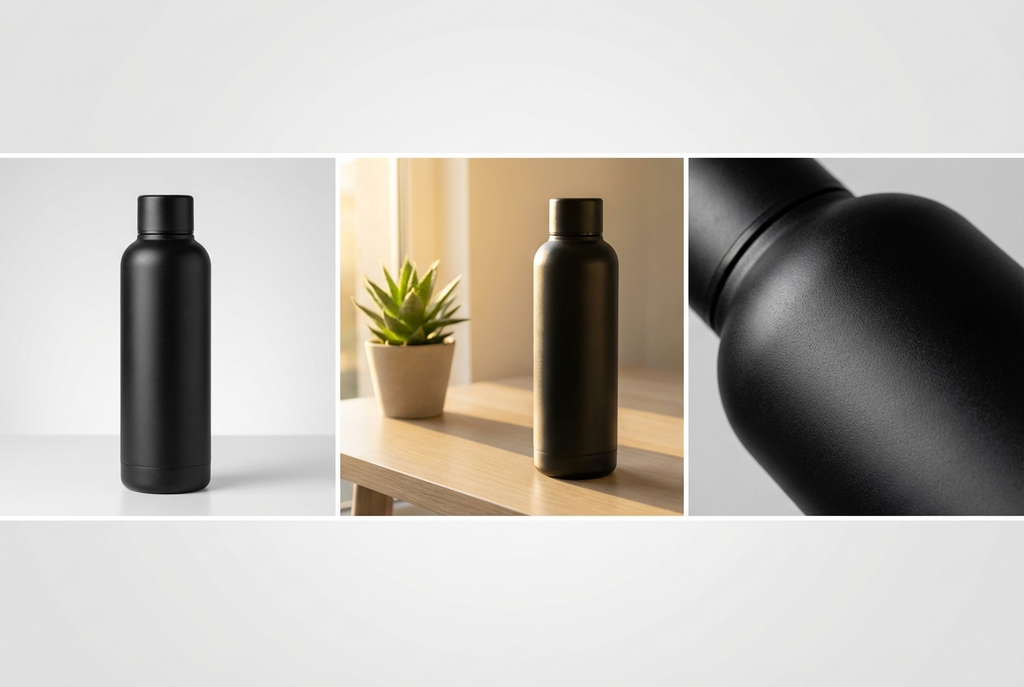
Instead of learning specialized syntax or keyword combinations, you describe the shot you want in plain language through a chat interface. You might say: “Show this water bottle on a clean white background with a soft shadow underneath.” The tool generates the image. Then you refine it: “Make the shadow softer. Try a version with warm morning light on a wooden desk.” Each adjustment builds on the previous result without starting over.
This conversational approach works particularly well for product imagery because e-commerce photography follows well-established visual conventions. White-background isolation shots, lifestyle contexts, and close-up detail views are predictable enough that a well-trained AI model can produce them reliably — provided the model has sufficient resolution and rendering accuracy.
Resolution Is Non-Negotiable for Marketplaces
Amazon requires a minimum of 1000 pixels on the longest side, but recommends 2000 pixels or higher for zoom functionality. Shopify themes routinely display product images at 2048 pixels wide. If your AI-generated image maxes out at 1024 x 1024, it will look soft or pixelated in exactly the context where sharpness matters most — when a customer pinches to zoom on a product detail.
The tools worth considering for e-commerce work output at 4K resolution (3840 x 2160) or higher. At that scale, material textures, stitching details, and surface finishes remain crisp even under zoom. This is the threshold where AI-generated product images become genuinely interchangeable with studio photography for most marketplace listings.
Multiple Formats Without Multiple Shoots
A single product image rarely serves every platform. You need a square crop for Instagram and marketplace thumbnails, a landscape banner for your Shopify store header, a vertical frame for Pinterest and TikTok product pins, and sometimes an ultra-wide format for advertising banners.
Traditionally, this means either shooting additional formats during the original session or cropping and reformatting existing images after the fact — both of which add cost and often compromise composition.
AI tools that support a broad range of native aspect ratios eliminate this problem entirely. You generate the same concept in the exact format you need for each channel. Some platforms now support 14 or more ratios, including ultra-wide formats like 21:9 and 4:1 that would be impractical to produce through traditional photography without specialized equipment.
Text and Labels on Product Images
One area where most AI tools still fail is rendering legible text within the image. Product labels, packaging copy, and branded overlay text often come out distorted or misspelled. For e-commerce sellers who need images showing their product label clearly, or marketers creating branded lifestyle shots with a tagline, this limitation rules out many AI tools entirely.
The models that handle text rendering well tend to use newer architectures specifically trained for typographic accuracy. If your product images require visible text — and for most consumer goods, they do — this capability should be a primary evaluation criterion.
A Practical Example
Banana AI Agent is a chat-based image generator built on Google’s Gemini models that addresses several of these requirements directly. It offers multiple model tiers within a single interface: Nano Banana for quick concept drafts in seconds, Nano Banana 2 for balanced output with 14 aspect ratios and up to 4K resolution, and Nano Banana Pro for maximum fidelity with precise text rendering and detailed compositions.
The workflow follows the conversational pattern described above. You describe the product shot, review the result, and refine through follow-up messages. The system maintains context across the conversation, so adjustments are iterative rather than starting fresh each time. You can also upload a reference photo of your product and ask the tool to generate variations in different settings and styles.
Pricing starts at $9.9 per month for 500 credits, with a free tier offering 10 credits to test the tool against your own products before committing. For context, a single product image at the highest quality tier costs around 10 to 20 credits — roughly $0.20 to $0.40 per image at the entry plan, compared to $30 to $50 for a traditional studio shot.
What This Means for E-Commerce Operations
The shift is not about replacing all professional photography overnight. High-end brand campaigns, lifestyle editorial shoots, and images that require physical models will continue to demand traditional production for the foreseeable future.
But for the volume work — the hundreds of white-background shots, the seasonal social media assets, the marketplace listings that need quick turnaround — AI image generation has reached a quality threshold where the output is good enough to use directly. The economics favor it strongly: faster turnaround, dramatically lower per-image costs, and the ability to generate multiple format variations from a single concept without additional production.
For e-commerce teams evaluating their visual content pipeline, the practical question is no longer whether AI can produce usable product images. It is whether the specific tool you choose can meet marketplace resolution standards, render text accurately, and fit into your existing workflow without creating more problems than it solves.
The best product photography tool is the one that gets your listings live faster without sacrificing the image quality your customers expect.

